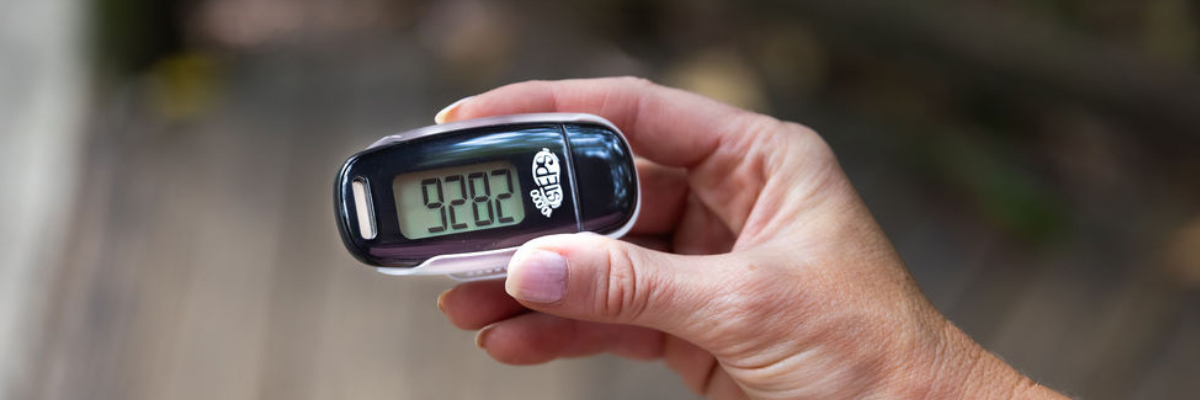
We have been Unpacking Australia's New 24-Hour Movement Guidelines for Adults, helping our members understand what is new and what it might mean to you. One of the new companion statements included in the guidelines says “for those who are able and track daily steps, aim for 7,000 or more steps per day.” which we thought was fantastic, but also may cause a little confusion as our program name is 10,000 Steps.
What does this mean for you?
An important nuance is that 7,000 isn’t a magic number. It is a helpful population-level benchmark, a number linked to meaningful health benefits in large groups of adults. As an individual, the amount of movement that is best for you will vary and it is important to remember that even small increases in your daily movement can go a long way towards your health.
What’s most important is increasing your daily movement in a way that works best for you, and that you can maintain. For example, movement isn’t only “steps,” we can also think about movement in terms of minutes of moderate and vigorous activity (e.g., swimming, cycling, or Pilates). To help simplify monitoring your physical activity data, the 10,000 Steps program allows you to convert minutes to ‘step equivalents’, for example 10 minutes of moderate physical activity would equate to 1,000 steps. Enter activity in minutes on your Dashboard.
Goals still matter - but find the goal that’s right for you
You may find reaching 7,000 steps is easy or you may find this target to be quite challenging. Movement goals, like a step goal, can be a practical way to make recommendations feel more concrete and help with your motivation to get out the door (1). The key is choosing a goal style that fits where you’re at right now - and how you want to feel while you’re working towards it.
Two goal styles that show promise are specific challenging goals and open goals.
Most of us have heard of specific goals (used in SMART goals). They’re clear and measurable - for example: “I will walk 7,000 steps each day this week” or “I’ll add 1,000 steps to my daily average by the end of the month.” Specific goals can be great when you already have some momentum and want structure, tracking, and clear targets. However, some individuals find this all or nothing approach to be stressful.
There is another option that can be especially helpful if you’re starting out, returning after time off, or noticing that rigid targets are dampening with your motivation. Open goals are flexible and exploratory, focusing on the extent of achievement rather than a fixed end target. For example: “See how many steps I can reach today” or “See how active I can be.” Research in physical activity suggests open goals can support more positive feelings during the process and that matters, because when movement feels better, it’s easier to repeat (2).
Rule of Thumb
- If you need freedom + and are looking to build confidence: try an open goal “See how many steps I can reach each day this week”
- If you want structure + precision: try a specific goal “Aim to hit 7,000 steps each day this week”
- If you like the best of both: mix them up “See how many steps I can get above my baseline of 5,000 steps each day this week”
Protect your motivation (and mental wellbeing) while goal setting
A common trap with physical activity goals is the “pass/fail” mindset: hit the number = success; miss it = failure. This can be difficult for motivation, and it can make people want to disengage entirely and this is why selecting the best goal for you is important.
Here are some motivation friendly swaps you can use if you feel yourself falling into the “pass/fail” mindset.
- Swap streaks and trends with focus on your overall weekly and average steps rather than trying to get it ‘right’ every single day.
- Swap out being strict and build in flexibility. Life happens - illness, deadlines, caring responsibilities. Your movement goal should be able to bend without breaking.
- Swap perfect goals for celebrating the small wins. +500 steps/day is progress. Parking the car further away is progress. Trying a new form of movement is progress.
Using the 10,000 Steps program to track your steps can allow you the flexibility to look at changes over time. You can sign up for our Monthly Challenges to have a goal for the month (allowing flexibility to your days). There are also some great stats in your Dashboard for you to check out: 7 Day Average Steps, Average steps per month, or you can use your totals and aim to increase your total Monthly Steps across the year.
How to use your personal movement benchmark as a tool
Here are practical examples for different starting points with options for both open and specific goals, and ideas on how to use the 10,000 Steps program to track your progress.
If you’re currently less than 3,000 steps/day…
- Aim: Build consistency and confidence.
- Open goal: “See how many days I can add extra movement this week.”
- Specific goal: “Add 500 steps/day to my usual average for the next 2 weeks.”
- 10,000 Steps action mixed goal: “Set my goal steps at 2,000 and see how much extra movement I can add to beat it each day.”
If you’re currently between 3,000-7,000 steps/day…
- Aim: Consider gradually increasing your daily average or benchmark, but don’t let it define you.
- Open goal: “Let’s see how much I lift my average week-by-week.”
- Specific goal: “Hit 7,000 steps on 3 days this week (then build to 4-5 days).”
- 10,000 Steps action mixed goal: “Set my goal steps at 3,000 and I will see how much I can beat it by each day.”
If you’re at 7,000+ steps/day…
- Aim: Remind yourself of your ‘why’ and seek to make movement not feel like ‘just another task’.
- Open goal: “Let’s see how active I can be while keeping it enjoyable.”
- Specific goal: “Add one longer walk each weekend,” or “Increase my weekly step total by 5-10% over 4 weeks.”
- 10,000 Steps action mixed goal: “Set my goal steps at 7,000 and I will aim to beat it each day.”
If you are easily hitting 10,000 steps a day by adding minutes of other activities, active transport or sport, but you find you don’t move much throughout the day.
- Aim: Replacing sedentary time with active time is a great way to consider your movement across 24 hours.
- Specific goal: “I will get up from my desk and walk for five minutes at least once every hour between 9am and 5pm on my workdays.”
- Open goal: “I will not log my minutes, but focus on seeing how many steps I can reach by the end of the workday when I take regular movement breaks.”
- 10,000 Steps action mixed goal: "I will set my goal as 7,000 steps a day for only steps walked and not log my minutes of moderate and vigorous activity."
Remember, step counts don’t replace other important movement and planned movement doesn’t mean you can sit for the rest of the day. The World Health Organization emphasise building activity across the week (and limiting sedentary time) (3), so consider mixing walking with other forms of aerobic activity, strength, balance, or sport.
The new Australian 24-Hour Movement Guidelines also recommend that we should be engaging in several hours of light intensity physical activity every day – this reminds us to balance movement, sleep and sedentary behaviour across your day. So find what fits for you, and make sure your movement, and goals align with what you enjoy.
About the Author
Dr Melanie Clarke is a Postdoctoral Research Fellow at Southern Cross University and member of the Open Goals Lab, led by Professor Christian Swann. The Open Goals Lab involves a collection of researchers who focus on goal setting and, in particular, open goals. Melanie completed her PhD in paediatric medicine at the Murdoch Children's Research Institute at University of Melbourne and has expertise in cardiovascular exercise physiology. Her primary interest is using exercise/physical activity to improve physical and mental health outcomes, and equipping individuals with the tools to be successful in lifelong physical activity engagement. Additional members of the Open Goals Lab include, Dr Scott Goddard, Graduate Researcher Davide Gargioli, Graduate Researcher Joseph Greer, Graduate Researcher Grace Redden, and Graduate Researcher Jack Sargent.

Open to Move - a new program to help you be active

Unpacking Australia’s New 24‑Hour Movement Guidelines and Daily Step Target
Want to exercise more? Try setting an open goal for your New Year’s resolution
References
- McEwan, D., Harden, S. M., Zumbo, B. D., Sylvester, B. D., Kaulius, M., Ruissen, G. R., Dowd, A. J., & Beauchamp, M. R. (2016). The effectiveness of multi-component goal setting interventions for changing physical activity behaviour: A systematic review and meta-analysis. Health Psychology Review, 10(1), 67–88. https://doi.org/10.1080/17437199.2015.1104258
- Swann, C., Buchan, J., Calleja, E. A., Goddard, S. G., Clarke, M. M., Hawkins, R. M., Jackman, P. C., Schweickle, M. J., Vella, S. A., & Rosenbaum, S. (2026). Goal Setting in Exercise and Physical Activity: An Expert Statement on Behalf of Exercise and Sports Science Australia. Sports Medicine. https://doi.org/10.1007/s40279-025-02373-5
- Bull, F. C., Al-Ansari, S. S., Biddle, S., Borodulin, K., Buman, M. P., Cardon, G., Carty, C., Chaput, J.-P., Chastin, S., Chou, R., Dempsey, P. C., DiPietro, L., Ekelund, U., Firth, J., Friedenreich, C. M., Garcia, L., Gichu, M., Jago, R., Katzmarzyk, P. T., … Willumsen, J. F. (2020). World Health Organization 2020 guidelines on physical activity and sedentary behaviour. British Journal of Sports Medicine, 54(24), 1451–1462. https://doi.org/10.1136/bjsports-2020-102955
- Ding, D., Nguyen, B., Nau, T., Luo, M., Cruz, B. del P., Dempsey, P. C., Munn, Z., Jefferis, B. J., Sherrington, C., Calleja, E. A., Chong, K. H., Davis, R., Francois, M. E., Tiedemann, A., Biddle, S. J. H., Okely, A., Bauman, A., Ekelund, U., Clare, P., & Owen, K. (2025). Daily steps and health outcomes in adults: A systematic review and dose-response meta-analysis. The Lancet Public Health, 10(8), e668–e681. https://doi.org/10.1016/S2468-2667(25)00164-1