The government has just released an update of the Australian 24-Hour Movement Guidelines for Adults. For physical activity professionals, this is an exciting update as the evidence has grown and while most important elements remain the same, some entirely new elements have been added. For example, the new guidelines are actually a 24-hour movement guideline that incorporates physical activity, sedentary behaviour and sleep. And for the first time worldwide, a daily step recommendation is part of the supporting information that explains how people can achieve the guidelines. That’s awesome news, but wait…what? It’s not 10,000 Steps a day! Let’s have a closer look!

Before we dig into the new guidelines it is worth pointing out that Governments and scientists don’t just pull guidelines from thin air. Rather, it is an extremely rigorous and detailed process that reviews all existing evidence from large population-based studies with tens of thousands of participants. Specifically, studies that examine ‘dose-response’ effects are reviewed to establish how much of a good thing (e.g., physical activity, sleep) or bad thing (e.g., sedentary time) is needed to influence health outcomes.
OK, now we have that out of the way, the guideline begins with pointing out that for health benefits, it’s not just about being active every day, but also about limiting how much you sit and making sure you sleep enough.
Physical Activity Guidelines
Specifically, for physical activity the guidelines recommend one should strive for 30-minutes or more of moderate- to vigorous-intensity physical activities on most days (accumulation 2.5 hours or more per week). They also recommend engaging in muscle-strengthening activities on 2 or more days per week. So far so good, all this is pretty much the same as the previous guidelines. However, for the first time the guidelines recommend engaging in several hours of light intensity physical activity every day.
This is based on evidence that every move (or step!) counts (1), and of course every hour you engage in light intensity activity, is one less hour of sedentary behaviour. Additionally, the guidelines recommend engaging in activities to improve mobility, balance and coordination on 3 or more days of the week. Previously, this was only recommended to older adults, but now its recommended for all adults.
Alongside the guidelines there are some ‘companion statements’ that are aimed to help people achieve the recommendations. These refer to well-known concepts, such as start small then increase frequency, intensity and duration, and that physical activity of any duration is associated with improved health outcomes. However, a major novelty here is reference to a specific number of steps a day to achieve the physical activity recommendation!
7,000 Steps!
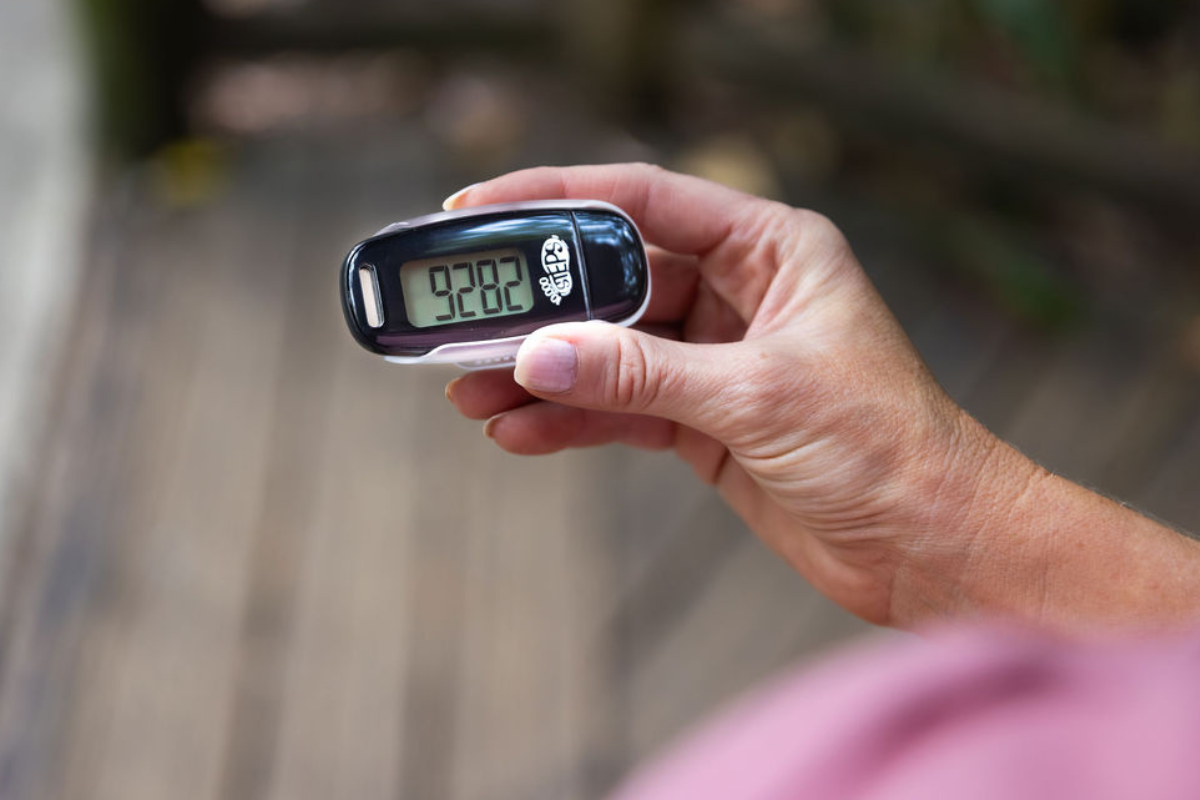
Australia is the first country to refer to a specific number of steps in their physical activity recommendations, and this is because only now there is enough evidence to do so. A large meta-analysis (a study that examines the evidence from lots of other studies) by Ding et.al., found that most of the health benefits from being active (i.e., reduction in the likelihood for developing cardiovascular disease, cancers, type 2 diabetes, depression, dementia, falls,…) were achieved around 7,000 steps a day (2). Hence, the recommendations now state: ‘Tracking daily activity can be a useful way to set goals and monitor progress. This could include monitoring steps or recording time spent in different activities. For those who are able and track daily steps, aim for 7,000 or more steps per day.’
“Our research helps to shift the focus from perfection to progress. Even small increases in daily movement can lead to meaningful health improvements”
What does this mean for using the 10,000 Steps program?
To be frank: it’s business as usual! Our program name has always been aspirational and motivational. We have known for many years of studies that show many health benefits can be achieved with less than 10,000 steps (3). But now its ‘official’! When new people sign up to the program we have always recommended to first establish what your ‘baseline’ step level is, before you make an effort to increase it.
For some their baseline level will be low (e.g., 2,000 steps/day) and for others it will be higher (e.g., 7,000 steps/day). The main aim of the 10,000 Steps program is to support you to take more steps than you did previously, irrespective whether that means you reach the magical 10,000 steps per day or not. For those with a high baseline step level, reaching 10,000 Steps a day will be a realistic goal.
However, it might not be for those with a low baseline step level. The most important thing is that your step increases are sustainable in the long run. There is little point increasing your steps from, for example, 2,000 to 10,000 a day, if you can only keep it up for a couple of weeks before falling back to your old activity levels.
It is far more valuable if you go from, for example, 2,000 to 5,000 steps per day and then keep it up forever. It takes about 10 minutes to take a 1,000 steps if you walk continuously, hence 3,000 extra steps a day aligns with the physical activity recommendation of 30 minutes per day.
Finally, the 7,000 steps a day recommendation doesn’t mean there’s anything wrong with achieving 10,000 steps or more a day. The research merely pointed out that you will reach most of the health benefits from walking with 7,000 steps a day (2). More health benefits and weight loss, can be obtained with 10,000 steps a day.
So, 10,000 steps can still be a viable target for those who are more active. On the opposite end, the research points out that even a modestly increased step count (e.g., to 4,000 steps/day) was already associated with a substantial health risk reduction (2). Therefore, ‘Every step counts’ regardless of meeting any specific target!
Let’s now look at the other areas of focus for the movement guidelines.
“The most important thing is that your step increases are sustainable in the long run.”
Sedentary Behaviour
For nearly 2 decades the evidence has been building, indicating that prolonged sedentary behaviour isn’t good for your health (4). Hence, the new 24-hour guidelines recommend limiting the amount of time spent being sedentary and to break up prolonged periods of sitting as often as possible.
Replacing sedentary behaviour with any type of physical activity will improve health. While standing may be a practical transition from being sedentary to more active alternatives, just standing more is not in the recommendations. Engaging in more physical activity is preferred over standing more.
Sleep
In line with previous recommendations, adults are encouraged to have between 7 and 9 hours of good quality sleep, with consistent bed and wake-up times throughout the week. Sleep duration refers to hours of sleep attained, not the time spent in bed. Hence, you need to allow extra time in bed to fall asleep, as well as for the time you spend being awake throughout the night if you are not a good sleeper.
Good sleep quality refers to sleep that is refreshing and minimises sleepiness. In this context it is very important that people who become more active aren’t sleeping less. Trading sleep for physical activity is not recommended. Rather, increased activity or sleep should come from reducing sedentary time.
Tip: If you would like to build movement into your mornings, try shifting sedentary night-time behaviour into an earlier bedtime, allowing you to wake up earlier without affecting your total sleep time.
About the Author
Professor Corneel Vandelanotte leads the Physical Activity Research Group and the 10,000 Steps program at CQUniversity. He obtained his PhD in Physical Education at the Ghent University in Belgium. He began working at the University of Queensland in 2005 before moving to CQUniversity in 2009.
His research takes a population-based approach to health behaviour change and is focused on the development and evaluation of innovative and web, app, tracker and machine learning based physical activity interventions. He has published over 300 peer-reviewed journal articles in international scientific journals, and was named as the top researcher in the field of public health by The Australian’s 2025 and 2026 Research magazine, as well as being named a ‘Highly Cited Researcher’ by Clarivate on multiple occasions. He is Vice-President of the Asia-Pacific Society for Physical Activity, and the Editor-in-Chief for the Journal of Activity, Sedentary and Sleep Behaviours.

7,000 Steps a Day: What the New 24‑Hour Movement Guidelines Mean for Goal Setting
Want to exercise more? Try setting an open goal for your New Year’s resolution
References:
- Bull, F. C., Al-Ansari, S. S., Biddle, S., Borodulin, K., Cardoso, N. A., Buman, M. P., ... Willumsen, J. F. (2020). World Health Organization 2020 guidelines on physical activity and sedentary behaviour. British Journal of Sports Medicine, 54(24), 1451-1462. https://doi.org/10.1136/bjsports-2020-102955
- Ding, D., Nguyen, B., Nau, T., Luo, M., del Pozo Cruz, B., Dempsey, P. C., Munn, Z., Jefferis, B. J., Sherrington, C., Calleja, E. A., & Chong, K. H. (2025). Daily steps and health outcomes in adults: A systematic review and dose–response meta-analysis. The Lancet Public Health, 10(8), e668–e681.
- Tudor-Locke, C., Craig, C. L., Brown, W. J., Clemes, S. A., De Cocker, K., Giles-Corti, B., Hatano, Y., Inoue, S., Matsudo, S. M., Mutrie, N., & Oppert, J.-M. (2011). How many steps/day are enough? For adults. International Journal of Behavioral Nutrition and Physical Activity, 8, 79. https://doi.org/10.1186/1479-5868-8-79
- Biswas, A., Oh, P. I., Faulkner, G. E., Bajaj, R. R., Silver, M. A., Mitchell, M. S., & Alter, D. A. (2015). Sedentary time and its association with risk for disease incidence, mortality, and hospitalization in adults: A systematic review and meta-analysis. Annals of Internal Medicine, 162(2), 123–132.