In September 2026, CQUniversity's 10,000 Steps team travelled to Brisbane to attend the 2026 Health and Wellbeing Queensland Prevention Symposium. Guided by the theme "Building the Legacy of a Healthier Queensland", the Symposium celebrated and showcased prevention initiatives being delivered by and for Queenslanders. The Symposium brought together stakeholders from government, academia, and the prevention and sport sectors to share knowledge, exchange ideas and explore ways to improve the health and wellbeing of Queenslanders in the lead up to Brisbane 2032. Attending the Symposium provided an opportunity to share the impact of 10,000 Steps, learn from leading prevention experts, and explore new ways to support more Queenslanders to be physically active and healthy.
Take a look at our wrap up on Facebook.
Showcasing 10,000 Steps
The Symposium started on the right foot, literally, with HWQld leading a walk along South Bank. It was a great chance to connect with other attendees, enjoy some extra steps, and set the tone for an event centred on the role of physical activity in prevention.
As exhibitors, the 10,000 Steps team had the opportunity to engage with delegates from across Queensland and share how our program continues to support people to move more and improve their health and wellbeing. The exhibition space provided a valuable opportunity to connect with professionals working across prevention, health promotion, research and community settings, and to learn from the innovative work being delivered across the state. As one of Queensland's longest running evidence-based physical activity programs, 10,000 Steps continues to support preventive health by helping people build sustainable physical activity habits and providing organisations with practical tools to encourage active living.
One of the highlights of the Symposium was seeing our Project Leader, Professor Corneel Vandelanotte, present on the impact and evolution of 10,000 Steps. His presentation demonstrated how a long running, evidence based physical activity program can continue to adapt while supporting Queenslanders to build sustainable physical activity habits. The presentation aligned closely with many of the themes discussed throughout the Symposium, including the value of scaling proven initiatives, using data to inform decision making, and ensuring programs remain relevant to the communities they serve.
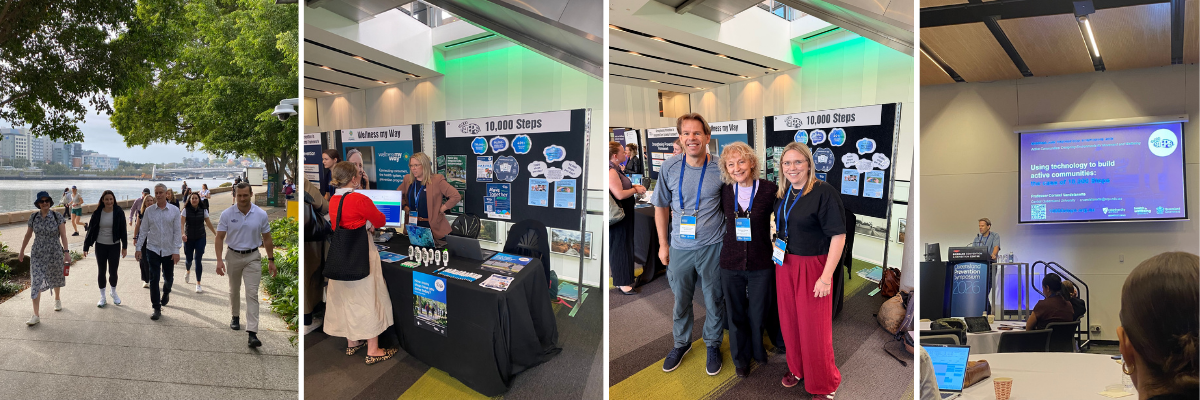
Left to right: Participants enjoying the Symposium walk along South Bank; the 10,000 Steps exhibition display; Current and previous 10,000 Steps Lead Investigators, Professor Corneel Vandelanotte and Professor Wendy Brown with Program Manager Anetta Van Itallie; and Prof. Vandelanotte presenting on Active Communities.
Working Together for a Healthier Queensland
Beyond individual projects and programs, many discussions focused on what it will take to meaningfully improve the health and wellbeing of Queenslanders now in the years ahead. A consistent message was that no single program or intervention can achieve this alone. Instead, progress will depend on stronger collaboration across all sectors, with each contributing their unique strengths and expertise.
Speakers challenged attendees to think beyond creating new programs and instead focus on strengthening and scaling approaches that are already demonstrating success. This included sharing data and insights, learning from one another, and recognising opportunities to partner with researchers and organisations that bring specialist expertise in different areas.
Importantly, discussions acknowledged that improving health outcomes requires more than a one size fits all approach. Communities across Queensland have different strengths, priorities and challenges, meaning successful prevention efforts must be adaptable, informed by local needs and designed with people at the center. The discussions reinforced that prevention is most effective when organisations work together, combining evidence, expertise and community connections to deliver meaningful and lasting health outcomes.
Creating a Sustainable Legacy Beyond Brisbane 2032
The Brisbane 2032 Olympic and Paralympic Games featured prominently throughout the Symposium, not simply as a major sporting event, but as an opportunity to create lasting benefits for Queensland communities. Speakers encouraged attendees to think about what legacy we want to leave beyond new infrastructure and venues, and how the momentum generated by the Games can be used to support healthier, more active lifestyles across the state.
A key takeaway was that success should not be measured by what happens during the Games alone, but by the positive changes that remain long afterwards. This includes creating environments that make physical activity more accessible, supporting participation across all ages and abilities, and ensuring more Queenslanders have opportunities to lead healthy and active lives.
For organisations working in prevention and health promotion, Brisbane 2032 represents a unique opportunity to build on existing efforts and inspire long term behaviour change. For programs such as 10,000 Steps, it provides an opportunity to encourage more Queenslanders to incorporate physical activity into their everyday lives and help ensure the health benefits of the Games extend well beyond 2032
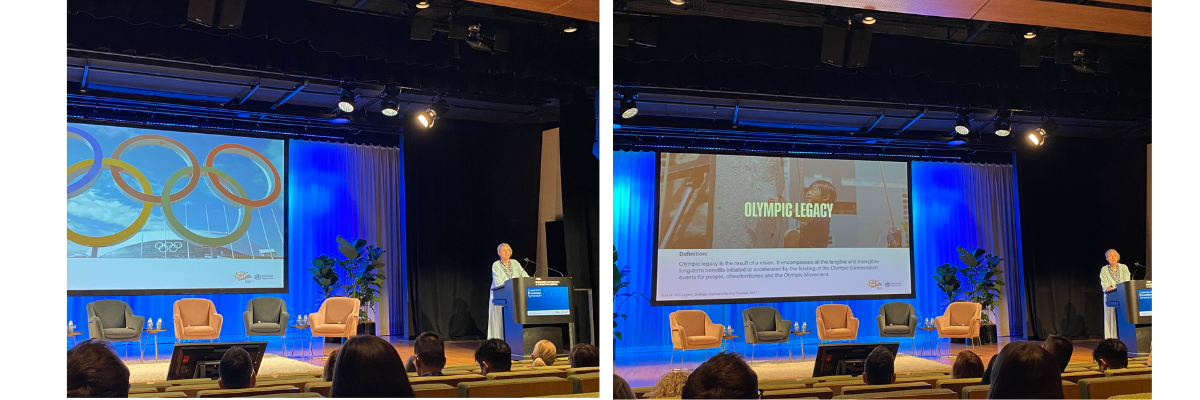
Dr Fiona Bull, Physical Activity Lead, World Health Organization, presenting Moving Towards Legacy: Creating Active and Healthier Communities Beyond Brisbane 2032.
Learning from Leaders
The Symposium commenced with an inspiring welcome from Dr Robyn Littlewood, Chief Executive Officer of Health and Wellbeing Queensland, and Her Excellency the Honourable Dr Jeannette Young AC PSM, whose reflections set the tone for two days focused on prevention, partnership and creating a healthier Queensland.
The program featured an impressive line up of speakers, each bringing a unique perspective on the opportunities and challenges facing the prevention sector. Highlights included presentations from Dr Fiona Bull from the World Health Organization, Mr Simon Kuestenmacher from The Demographics Group, and Dr Marianne Gale from Queensland Health.
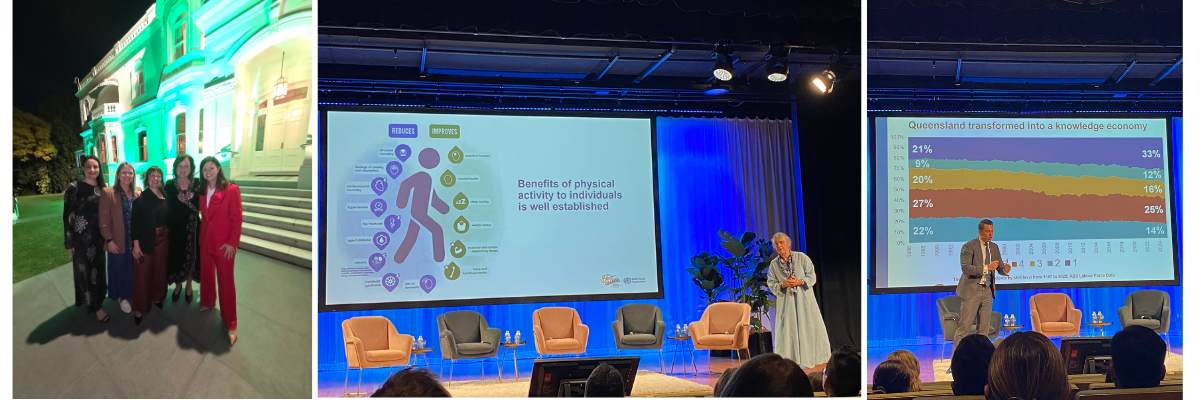
Left to right: Dr Sjaan Gomersall, 10,000 Steps Program Manager Anetta Van Itallie, Queensland Walks' Anna Campbell, and The Hon. Ms Joan Pease (MP), Health and Wellbeing Queensland CEO Robyn Littlewood at Government House; Dr Fiona Bull; Mr Simon Kuestenmacher, The Demographics Group, presenting Health and Wellbeing Prevention: Building a Healthier Queensland for the Future.
Strengthening Connections
Beyond the presentations, the Symposium provided a valuable opportunity to connect face to face with colleagues, partners and stakeholders from across Queensland's prevention sector. We enjoyed catching up with the team from Health and Wellbeing Queensland, colleagues from The University of Queensland, and partner programs including QCWA Country Kitchens, My Health for Life and Wellness My Way. We also welcomed the opportunity to connect with stakeholders such as Queensland Walks, whose work continues to support healthier and more active communities across the state.
Another highlight was meeting 10,000 Steps members in person during the Move Together Challenge. Connecting directly with participants and hearing about their experiences was a reminder of the real people behind the statistics, research and prevention initiatives discussed throughout the Symposium.
Hearing how members use 10,000 Steps in their daily lives also provided valuable insights into how the program supports physical activity and wellbeing across different communities.
The Symposium reinforced the important role prevention plays in improving the long term health and wellbeing of Queenslanders, and the value of partnerships in achieving population health outcomes. Through the ongoing partnership between CQUniversity and Health and Wellbeing Queensland, 10,000 Steps is proud to contribute to a shared vision of creating a healthier and more active Queensland. The ideas, research and connections gained through the Symposium will help inform the continued evolution of 10,000 Steps as we support individuals, workplaces and communities to move more and sit less.